
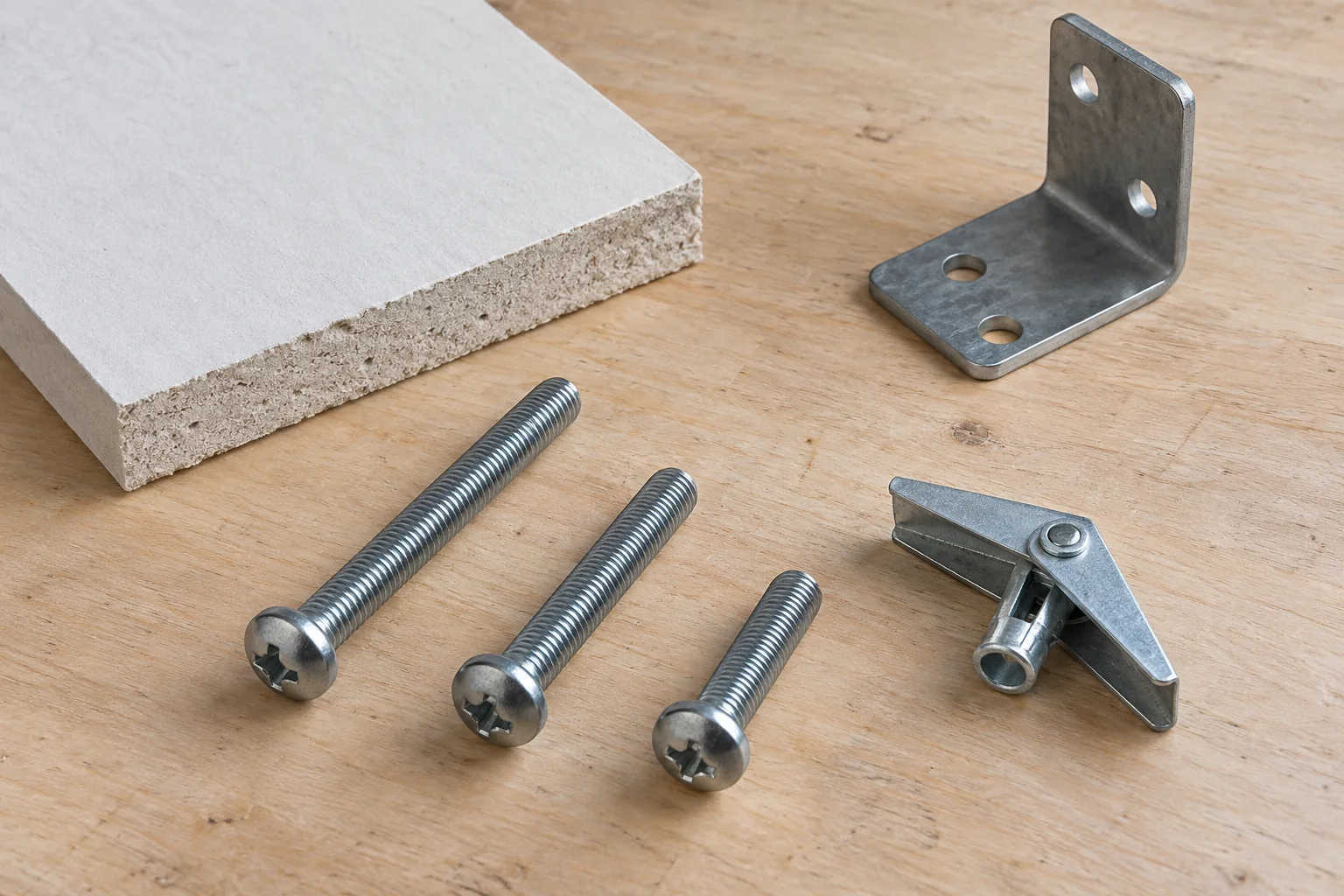
Direct answer: first identify the toggle mechanism
Use the minimum bolt length and assembly method published for the exact anchor. For the SNAPTOGGLE system in TOGGLER's linked technical flyer, minimum length is wall thickness plus the thickness of the item being attached plus 1/2 inch. That is a product-specific rule, not a universal allowance for every hollow-wall anchor.
A traditional spring-wing toggle has to pass through the fixture and wall while its wings are folded, then have space to open. Its maker's geometry and instructions govern the required length. Do not transfer a strap-toggle formula to an unidentified wing toggle or use a wood screw in a machine-threaded channel.
Keep four sizing decisions separate
Write the measurements in separate boxes before buying hardware. A package can use similar fractions for a bolt diameter, a hole diameter or a wall-thickness limit. Those numbers answer different questions; matching one does not establish the rest.
| Decision | What it checks | What it does not prove |
|---|---|---|
| Bolt diameter and thread | Whether the bolt matches the identified channel or wing | The required wall-hole diameter or bolt length |
| Wall grip range | Whether the anchor fits the verified wall thickness | Whether a bolt supplied in the bag is long enough |
| Bolt length | Whether the selected fastener reaches through the complete stack as instructed | Whether the hidden mechanism has room to deploy |
| Cavity / deployment space | Whether the mechanism and planned bolt can fit without obstruction | Whether the assembly is suitable for the intended load |
Measure the wall and fixture separately
Record all verified wall layers between the front surface and the rear bearing face. Two layers of 1/2-inch board total 1 inch; a visible sheet edge does not prove there is only one layer. Use existing safe access or reliable construction information rather than making an exploratory hole into an unknown service path.
At the actual mounting hole, measure the fixture and any required washer, spacer or standoff that occupies bolt length before the wall. Do not use the bracket's overall width or assume its folded edge has the same thickness as the hole location. Record each component so it is not omitted or counted twice.
Confirm where the exact fastener's length is measured. DEWALT's linked spring-toggle guide distinguishes round-head length measured below the head from flat-head length measured from its top. This illustrates why a ruler reading must match the head style and manufacturer's length reference; it is not permission to swap head styles on a fixture.
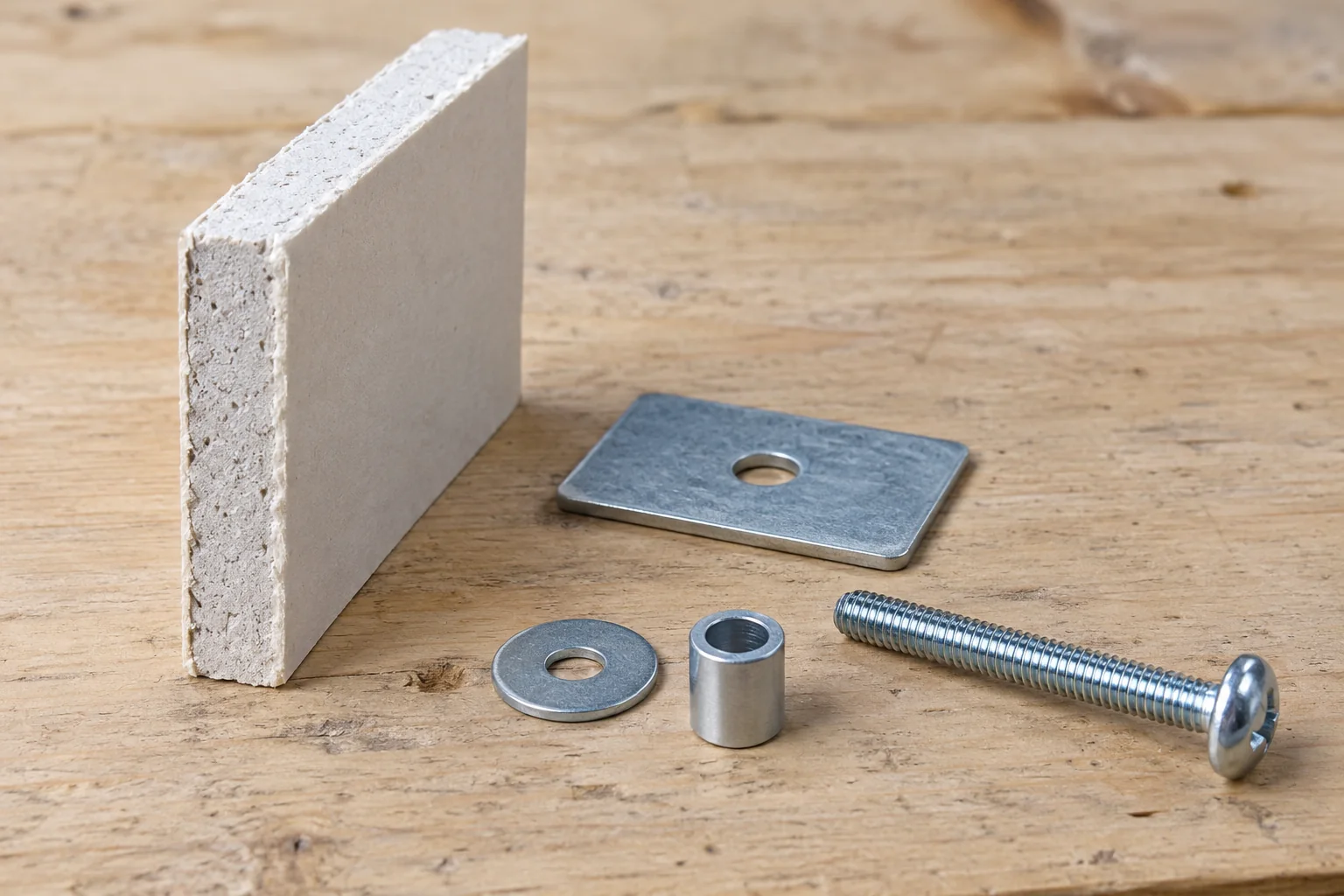
Worked SNAPTOGGLE length examples in inches
These are hypothetical arithmetic examples using only the linked SNAPTOGGLE rule: minimum bolt length = verified wall thickness + fixture-side stack + 1/2 inch. They do not select a load rating, drilling depth, available retail length or replacement bolt specification. Check the exact anchor's grip range and the mounted object's requirements first. For these examples, assume a non-countersunk round-head bolt measured from under its head, with the fixture-side stack measured from that bearing surface to the wall.
| Hypothetical verified wall | Fixture-side stack | Calculated minimum length |
|---|---|---|
| 1/2 inch | 1/8-inch plate | 1-1/8 inches |
| 5/8 inch | 1/4 inch total hardware | 1-3/8 inches |
| Two 5/8-inch layers = 1-1/4 inches | 1/4 inch total hardware | 2 inches |
| 1/2 inch | 1/8-inch plate + 1/4-inch approved spacer = 3/8 inch | 1-3/8 inches |
| Wall layers unknown | Any value | Not determined: verify the complete wall first |
- Use measured values, not the picture's apparent proportions
- Keep manufacturer-required hardware in the stack
- Match thread, head, material and any finish requirements
- If an approved length is unavailable, ask for a documented alternative rather than improvising
Why the supplied bolt may not cover the anchor's full grip range
TOGGLER lists BA and BB wall grip as 3/8–3-5/8 inches, while its ordering table identifies included bolts as 2-1/2 inches where bolts are supplied. The anchor's wall range and the contents of a particular package are separate checks; some catalog entries do not include bolts at all.
For a hypothetical 2-inch verified wall and 1/4-inch fixture-side stack, the same minimum-length arithmetic gives 2-3/4 inches. A 2-1/2-inch bolt is shorter than that result even though 2 inches is within the listed BA/BB wall range. This example flags a mismatch; it does not approve that wall assembly, a replacement bolt or the load.
Packaging conventions can differ between systems. DEWALT's current Strap-Toggle REV. B ordering table states that screws are not packaged with the anchors. An anchor's own catalog length is not a recommendation for machine-bolt length; check what is actually included before completing your hardware list.
Check space behind the wall independently
The linked SNAPTOGGLE flyer separately specifies at least 1-7/8 inches of clearance behind the wall. Its extra 1/2-inch bolt-length allowance is not the deployment-clearance requirement, and neither number is a depth-stop setting for drilling into a concealed wall.
Identify any blocking, backup wall or other obstruction through a safe, documented assessment. A bolt can satisfy the length calculation and still be unusable where its path or the mechanism is blocked. Do not assume insulation or an unidentified hard stop will move aside. If the available space cannot be reconciled with the complete instructions, stop and choose an approved mounting approach or qualified help.
Do not diagnose every failed start as a short bolt
A bolt that does not engage may be short, misaligned or the wrong thread. More force does not identify which problem you have. Keep the fixture unloaded, compare the bolt and channel specifications, and follow the exact maker's assembly sequence. A visibly similar wood, sheet-metal or machine screw is not an interchangeable substitute.
If tightening never clamps the fixture, or the bolt hits a hard stop before seating, stop rather than trimming hardware, enlarging the wall hole or forcing additional turns. Recheck the length reference, complete stack and anchor condition. A torn or oversized hole is a wall-repair and remounting issue, not something a longer bolt alone resolves.
A short pre-purchase worksheet
Keep the measurements with the current instruction sheet. Continue only when the mounted object permits the identified hollow-wall system and each fit requirement is known. If the intended attachment is actually into sound wood, use the separate screw-embedment guide instead of this hollow-wall calculation.
- Anchor brand, model and mechanism: recorded
- Permitted wall and installed object: verified
- Bolt thread and head style: matched
- Complete wall thickness: measured or documented
- Fixture, washer and approved spacer stack: totaled
- Grip and clear deployment space: checked separately
- Minimum length and a documented compatible fastener: confirmed
- Any unknown obstruction, damaged wall or contradictory requirement: stop
Frequently asked questions
Are 2-1/2-inch toggle bolts long enough for 1/2-inch drywall?
Wall thickness alone cannot decide. Include the fixture-side stack, identify the mechanism, match the bolt specification and verify grip and clear space. The SNAPTOGGLE rule shown here is a minimum-length calculation, not a universal approval for a 2-1/2-inch bolt.
Does a longer toggle bolt hold more weight?
Do not infer load capacity from added length. The mounting system, wall, spacing, condition and documented connection must be suitable; unnecessary extra length can also conflict with the available space.
Is the extra 1/2 inch the required clear space behind the wall?
No. In the linked SNAPTOGGLE instructions, the bolt-length allowance and the separate minimum 1-7/8-inch rear clearance are different checks. Neither is a universal drilling depth.
Can I apply the SNAPTOGGLE formula to a spring-wing toggle?
Not without that product's own instructions. A spring wing must pass through the fixture and wall in its folded state before opening. Follow the exact maker's deployment and length requirements.
Can I use the same calculation for a screw into a stud?
No. Wood-stud fastening depends on specified engagement in sound wood. A hollow-wall machine bolt engages a matching metal channel or wing; the two sizing problems are not interchangeable.
A practical next step
Before buying hardware, confirm the wall assembly and read the installation instructions for both the object and the exact fastener. If you need a starting category, use our Anchor Selector.
Sources and further reading
These primary and manufacturer resources support the safety and installation principles summarized above. Always use the current instructions for your exact product.
- SNAPTOGGLE Heavy-Duty Toggle Bolts: Installation Data, REV. 3/24 — TOGGLER
- SNAPTOGGLE Carbon-Steel Product and Ordering Information — TOGGLER
- Strap-Toggle Technical Guide, REV. B (2025): Package Contents and Installation — DEWALT
- Toggle Bolt Technical Guide, REV. c: Assembly and Head-Length References — DEWALT