
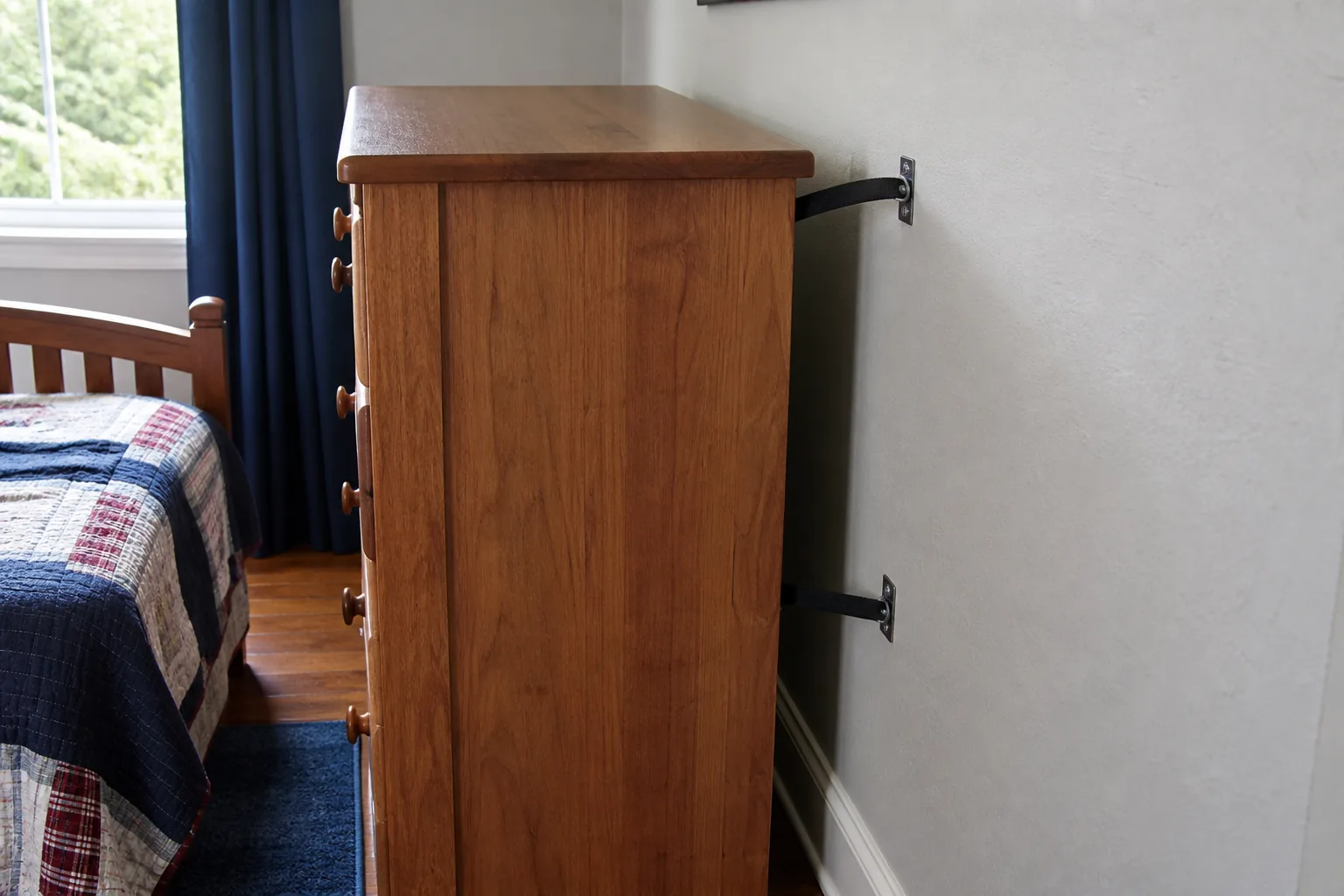
Understand the hazard
A loaded drawer shifts the center of gravity forward, and climbing or pulling creates additional overturning force. Furniture that seems stable while empty can become unstable on carpet, an uneven floor or when several drawers are open.
The U.S. Consumer Product Safety Commission’s Anchor It! campaign recommends anchoring top-heavy furniture and securing televisions. Treat the project as child-safety work when children live in or visit the home.
- Dressers and chests
- Bookcases and shelving units
- Freestanding wardrobes
- TV stands and entertainment furniture
- Appliances covered by manufacturer restraints
Use the correct furniture-side attachment
Find the manufacturer-designated structural point. Thin back panels, cardboard dust covers and decorative trim may not carry a restraint load. Some furniture includes threaded inserts or a reinforced top rail; use those locations and the supplied hardware.
Do not substitute a brittle plastic strap, picture wire or unknown bracket. If hardware is missing, obtain the manufacturer’s replacement kit or a restraint explicitly compatible with the furniture construction.
- Locate a structural rail or approved insert
- Inspect the restraint for damage
- Use supplied screw sizes
- Do not weaken panels with extra holes
Make a verified wall connection
Locate framing or the wall attachment required by the restraint instructions. Confirm stud boundaries and consider utilities before drilling. Calculate screw penetration after the finish and bracket while avoiding unnecessary depth.
A hollow-wall anchor should be used only when the restraint maker specifically accepts it for the wall assembly. Generic drywall capacity is not an adequate substitute for a safety restraint. Masonry and metal-stud walls require methods designed for those substrates.
- Verify wall construction
- Align restraint without twisting
- Use an approved structural fastener
- Maintain required screw embedment
- Install all provided restraints
Position and tension the restraint
Place furniture where it sits flat and does not rock. Adjust feet or use manufacturer-approved leveling methods before anchoring. Route the restraint so it is short, direct and not cut by a sharp furniture edge.
Remove slack according to the instructions without lifting the furniture or pulling the wall bracket sideways. Some systems allow limited movement for cleaning; others are intended to remain tight. Reinstall the restraint whenever furniture is moved.
- Level the furniture
- Keep the strap path direct
- Avoid sharp bends
- Engage locking hardware
- Do not leave accessible loops
Combine anchoring with safer use
Place heavy items in lower drawers, do not put tempting toys or remotes on top and discourage climbing. Secure a television separately as its manufacturer directs. Anchoring reduces risk but does not make unsafe use harmless.
Inspect restraints after moving, impact, remodeling or visible loosening. Replace damaged components rather than knotting or repairing them. Tenants should coordinate permitted attachment and repair responsibilities with the property owner without delaying an urgent child-safety plan.
Frequently asked questions
Is heavy furniture safe without an anchor?
Weight alone does not prevent tip-over. Follow CPSC and manufacturer guidance for top-heavy furniture and televisions.
Can I attach the strap to the thin back panel?
Not unless the furniture maker identifies it as an approved structural attachment point.
Do renters need permission?
Lease requirements vary, but tip-over protection is a serious safety issue. Coordinate promptly with the owner and use the manufacturer’s approved solution.
A practical next step
Before buying hardware, confirm the wall assembly and read the installation instructions for both the object and the exact fastener. If you need a starting category, use our Anchor Selector.
Sources and further reading
These primary and manufacturer resources support the safety and installation principles summarized above. Always use the current instructions for your exact product.
- Anchor It! Furniture and TV Safety — U.S. Consumer Product Safety Commission
- General Electrical Safety Requirements — Occupational Safety and Health Administration