
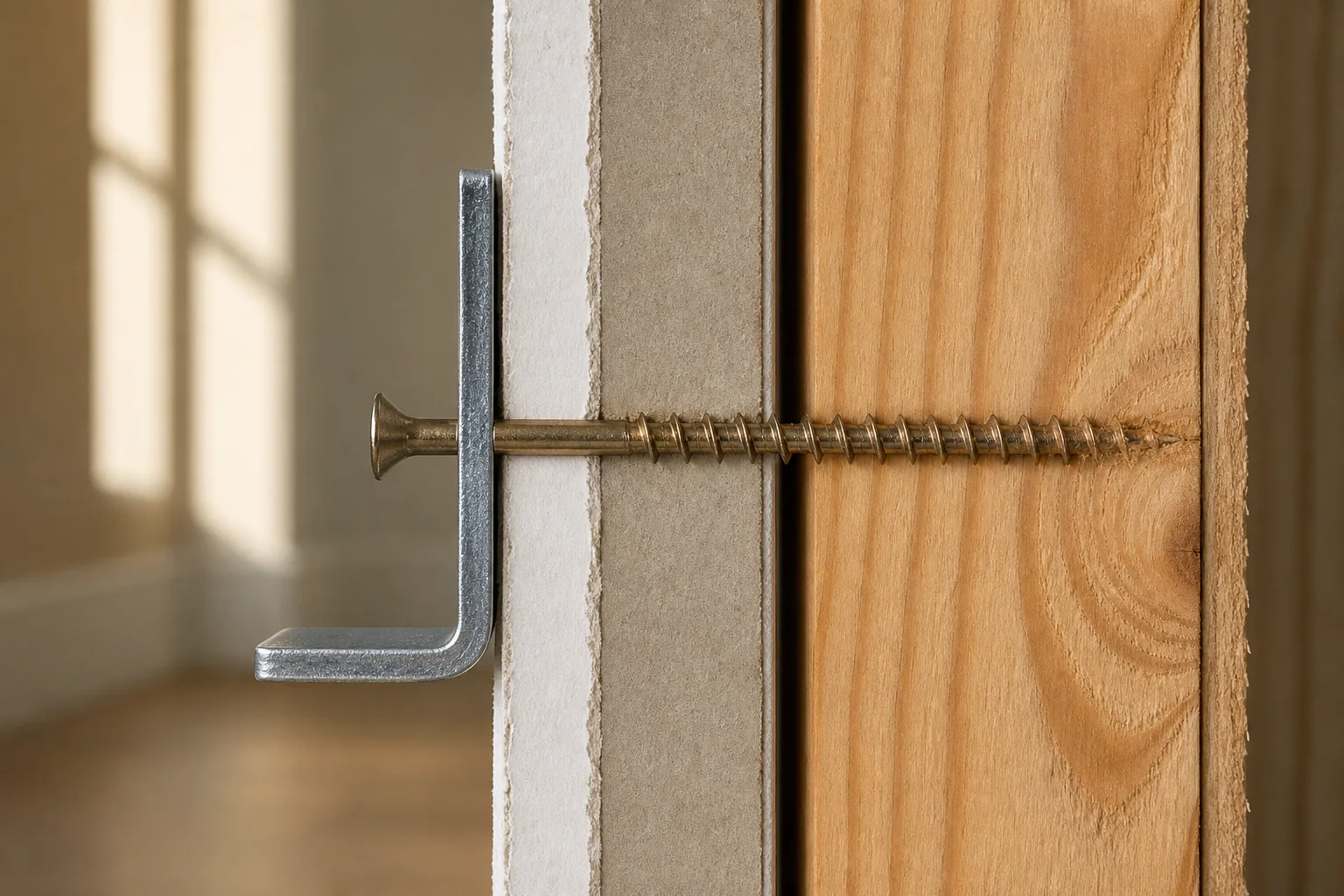
Calculate actual embedment
Subtract the bracket, washer, spacer and wall-finish thickness from the screw's usable length. The attachment instructions should state the required fastener and minimum embedment for that product. Do not replace an engineered mounting fastener based only on appearance.
- Total fastener length
- Minus hardware stack
- Minus drywall or other finish
- Equals approximate embedment in wood
Pilot holes matter
A correct pilot hole helps reduce splitting and excessive driving torque. Diameter and depth depend on screw type, wood species and manufacturer instructions. Keep the hole centered in the stud as required by the mounting system.
Know when to stop
Unexpected hard resistance may indicate a protective nail plate. Empty resistance may mean you missed the stud. Do not keep driving a longer fastener to see what happens; verify the location and utility risk first.
Create a fastener stack-up
Lay out every layer the screw must pass through: washer, bracket, spacer, tile or panel, drywall and any gap before the stud. Subtract those thicknesses from the usable threaded length. The remainder is approximate wood embedment, which must meet the mount manufacturer’s requirement without creating unnecessary penetration.
Account for an unthreaded shoulder, countersink and screw tip when the instructions distinguish effective thread engagement. A screw labeled by overall length does not guarantee that the same length of full-diameter thread reaches the framing.
- Bracket and washer thickness
- Spacers or standoffs
- Finish layer thickness
- Any known gap or furring
- Usable thread embedded in sound framing
Centering and pilot holes matter as much as depth
A long screw near the edge of a stud is not equivalent to a correctly centered one. Confirm the stud boundaries with more than one reading and place the hole where the mounting system instructs. A suitable pilot hole reduces splitting and driving torque without removing the wood needed for thread engagement.
Pilot diameter depends on screw geometry, wood species and the manufacturer’s table. Keep the hole aligned with the planned fastener path. If the bit breaks into a void sooner than expected, stop rather than assuming the stud is narrow or continuing with a longer screw.
- Confirm both stud edges
- Mark the centerline
- Use the required pilot diameter and depth
- Keep the drill square
- Drive at controlled speed and torque
Avoid utilities and protective plates
Electrical cable and plumbing can pass through bored framing. Metal protection plates are installed where required to help protect vulnerable utilities from fasteners. Unexpected hard metal resistance is therefore a stop signal, not an invitation to switch to a stronger bit.
Review the surrounding room, fixtures, outlets and plumbing before choosing a location. No consumer detector can guarantee that a wall is clear. When the fastener path or wall construction is uncertain, relocate the installation or use qualified help.
Frequently asked questions
Is a longer screw always stronger?
No. Length beyond the required embedment may add no useful capacity and can increase the chance of contacting concealed utilities.
Does drywall thickness count as stud embedment?
No. Embedment is the portion of the fastener engaged in sound structural wood after all finish and hardware layers.
What does sudden metal resistance mean?
Stop. It may be a protective plate, metal framing or another concealed component that must be identified before proceeding.
A practical next step
Before buying hardware, confirm the wall assembly and read the installation instructions for both the object and the exact fastener. If you need a starting category, use our Anchor Selector.
Sources and further reading
These primary and manufacturer resources support the safety and installation principles summarized above. Always use the current instructions for your exact product.
- Sheetrock Installation and Finishing Guide — USG
- General Electrical Safety Requirements — Occupational Safety and Health Administration