
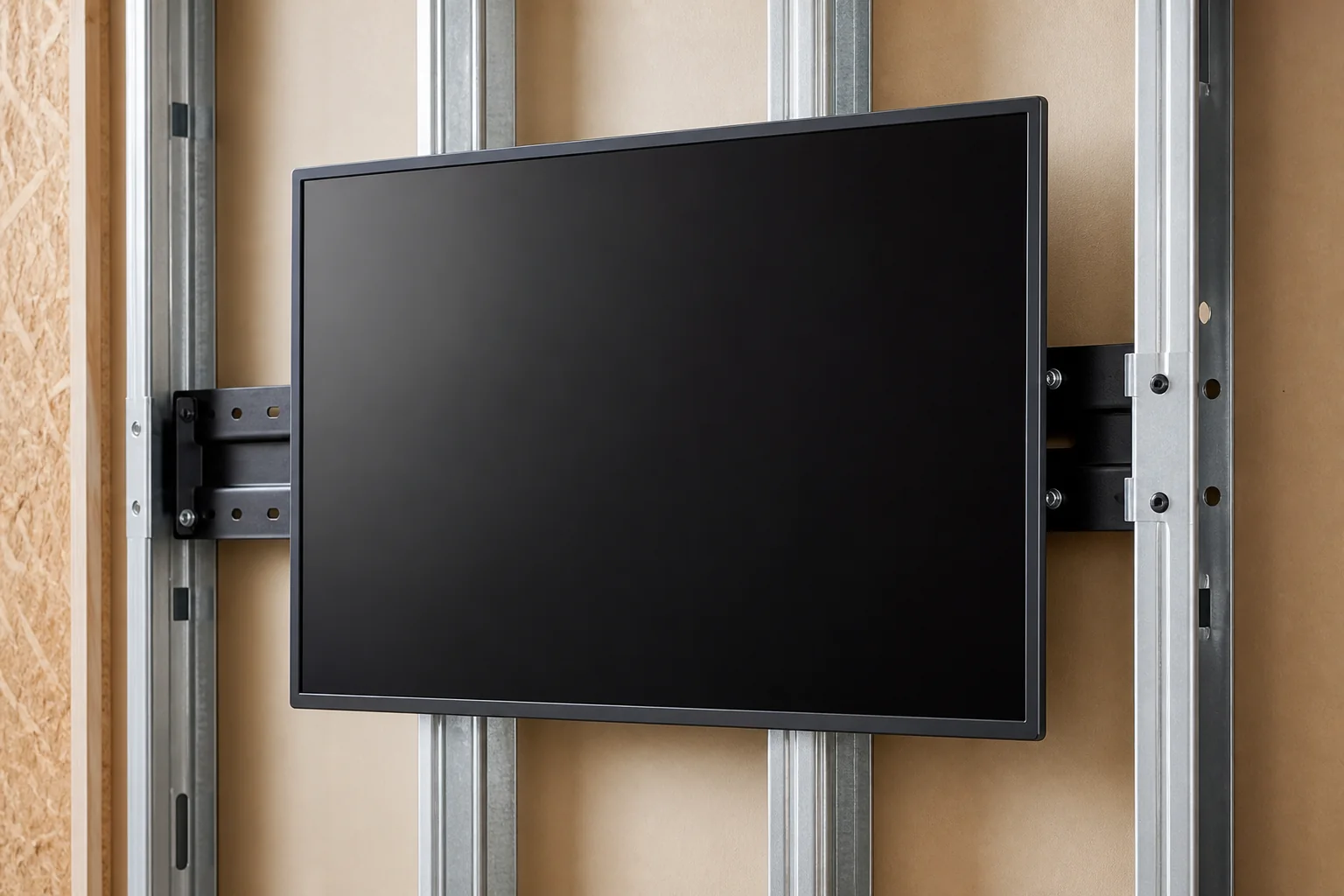
Verify before buying fasteners
Read the TV mount instructions for approved substrates. Identify the metal framing and wall layers without relying on a single stud-finder signal. Confirm whether the system requires blocking, multiple studs or a fastener tested for the full assembly.
- Mount type: fixed, tilting or full-motion
- TV plus mount weight
- Stud spacing and gauge
- Drywall layers and thickness
- Approved fastener system
Why leverage changes the problem
A full-motion arm moves the television away from the wall and increases the moment on the attachment. Static weight alone does not describe that demand. This is why a generic anchor rating is not a substitute for the mount maker's substrate instructions.
Professional help is reasonable
Consider an installer when framing details are unknown, the screen is large, utilities complicate the location or the manufacturer does not provide a metal-stud method. The cost of verification is small compared with a failed installation.
Start with the mount’s approved wall types
Locate the installation manual for the exact mount model and read its substrate section before buying fasteners. Some manuals address wood studs and concrete only. A generic online metal-stud method does not expand the manufacturer’s approved applications.
Record the television weight, mount weight, VESA position, stud spacing, stud gauge if known, drywall layers and whether the arm is fixed, tilting or full-motion. A full-motion arm can create substantially more leverage than a fixed mount even when the screen weighs the same.
- Exact mount model and manual
- TV plus mount weight
- Fixed, tilting or articulating geometry
- Stud spacing and accessible holes
- Framing gauge and complete wall assembly
Understand the attachment options
Depending on the engineered system, an installation may use approved fasteners through the stud flange, toggles through the full assembly, plywood or wood blocking added behind the finish, or a mounting plate that distributes connections across multiple studs. These are not interchangeable shortcuts; each depends on compatible hardware and a known wall build-up.
Self-drilling sheet-metal screws chosen only by appearance may have insufficient thread engagement or pull-out performance for a cantilevered mount. Likewise, a hollow-wall anchor rating does not automatically include the metal stud, multiple drywall layers or the mount’s moment.
- Use only a method permitted by the mount maker
- Verify cavity and stud geometry
- Keep every fastener compatible with the bracket
- Add blocking when the approved design requires it
Plan cables separately from structure
Do not route ordinary power cords through a wall cavity. In-wall power and low-voltage work have different requirements and may require listed components or a qualified electrician. Keep cable planning from forcing the structural fasteners into an unverified location.
Before drilling, consider outlets, switches, plumbing and shared walls. Stop at unexpected resistance. After mounting, verify that the bracket is fully engaged, safety screws are installed and cords have enough slack throughout the arm’s complete travel without being pinched.
Frequently asked questions
Can a TV be mounted on metal studs?
Sometimes, but only with a method approved for the exact mount and verified wall assembly. Unknown framing or a full-motion arm may warrant professional installation.
Are drywall anchors enough if a metal stud is present?
Do not assume so. The complete attachment must be evaluated as a system, including the stud, board layers, fastener and mount geometry.
Can I put the TV power cord inside the wall?
Ordinary flexible power cords are generally not intended as concealed permanent wiring. Use code-compliant listed solutions or an electrician.
A practical next step
Before buying hardware, confirm the wall assembly and read the installation instructions for both the object and the exact fastener. If you need a starting category, use our Anchor Selector.
Sources and further reading
These primary and manufacturer resources support the safety and installation principles summarized above. Always use the current instructions for your exact product.
- Anchor It! Furniture and TV Safety — U.S. Consumer Product Safety Commission
- General Electrical Safety Requirements — Occupational Safety and Health Administration