
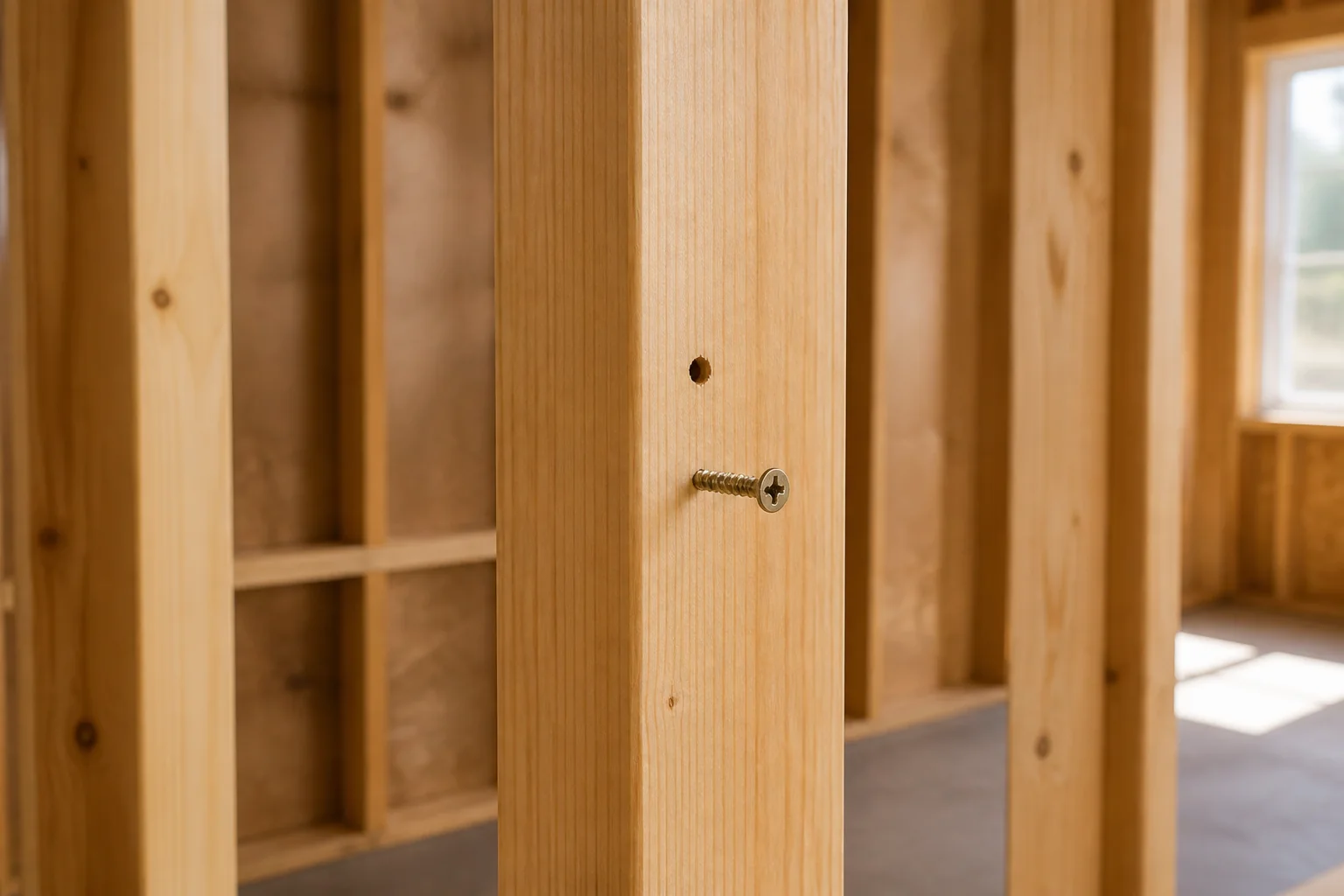
What counts as structural wood
A detector can respond to dimensional studs, engineered framing, wood blocking, furring, trim backing or a cabinet rail. Those elements do not all have the same dimensions or structural role. Confirm that the mounting instructions permit the identified member.
Studs commonly run vertically, but walls around windows, doors, corners and utilities include headers, trimmers, plates and blocking. Remodels can add layers or furring that change the distance from the finished surface to structural wood.
- Dimensional lumber stud
- Engineered framing
- Purpose-installed blocking
- Nonstructural furring
- Multiple members around openings
Locate the member and its center
Combine electronic readings, aligned drywall-fastener locations, construction clues and safe observation in unfinished areas. Map both edges where possible, then mark a centerline. One signal does not establish the width or drilling path.
Confirm every required fastener position independently. Common framing spacing can help generate the next candidate, but actual construction varies. A wide reading may indicate doubled framing, blocking, plumbing or another concealed object.
- Find both edges
- Repeat at more than one height
- Compare with visible fastener patterns
- Treat standard spacing as a clue only
Calculate the fastener stack
List the washer, bracket, spacer, wall finish and any known gap before the stud. Subtract those layers from the fastener’s usable threaded length to estimate embedment in wood. The mount manufacturer should provide the required screw and minimum engagement.
Overall screw length is not the same as effective full-diameter thread in the stud. An unthreaded shoulder, countersink and point can affect the connection. Longer is not automatically safer when concealed utilities may cross the framing.
- Hardware thickness
- Finish thickness
- Spacer and gap
- Usable thread length
- Required wood embedment
Select and drill the pilot hole
Pilot diameter and depth depend on screw geometry, wood species and manufacturer instructions. A correct pilot helps control splitting and driving torque while retaining enough wood for thread engagement. Use the exact value when one is supplied.
Keep the bit square and centered. Limit depth with a stop or marked bit where appropriate. If the bit enters a void early, wanders or encounters hard metal, stop and reassess the member and path.
- Use a sharp compatible bit
- Center the pilot
- Control depth
- Remove chips without wallowing
- Do not defeat metal protection
Tighten the fixture without crushing the wall
Use the washer and screw head style required by the bracket. Bring multiple fasteners up evenly so the fixture seats flat. Spacers or shims may be needed when the mounting instructions permit them; do not bend a bracket against an uneven wall with torque.
Stop at the stated torque or secure-seating condition. Stripped threads, continued rotation, wall compression or a bowed bracket require unloading and diagnosis. A controlled inspection is appropriate; hanging body weight from the fixture is not.
- Keep the bracket flat
- Use every required structural point
- Tighten in stages
- Install safety locks and retainers
Know when wood-stud mounting is still not enough
The stud may be in the wrong place for the bracket pattern, too narrow for all required holes or part of an unknown partition. Cabinets, grab bars, full-motion mounts and overhead equipment can require blocking, multiple studs or engineered installation.
Do not modify the mounted product’s bracket or reduce its fastener count to reach one stud. Choose a compatible mounting plate, open and reinforce the wall, relocate the object or use a qualified installer.
Frequently asked questions
How do I know the screw is centered in a stud?
Find both edges with more than one method, mark the center and keep the pilot perpendicular. A single beep is insufficient.
Does drywall count toward embedment?
No. Structural embedment is the thread engaged in sound wood after all wall and hardware layers.
Should I drill through a metal plate over a stud?
No. Stop. The plate may protect wiring or plumbing and should not be defeated.