
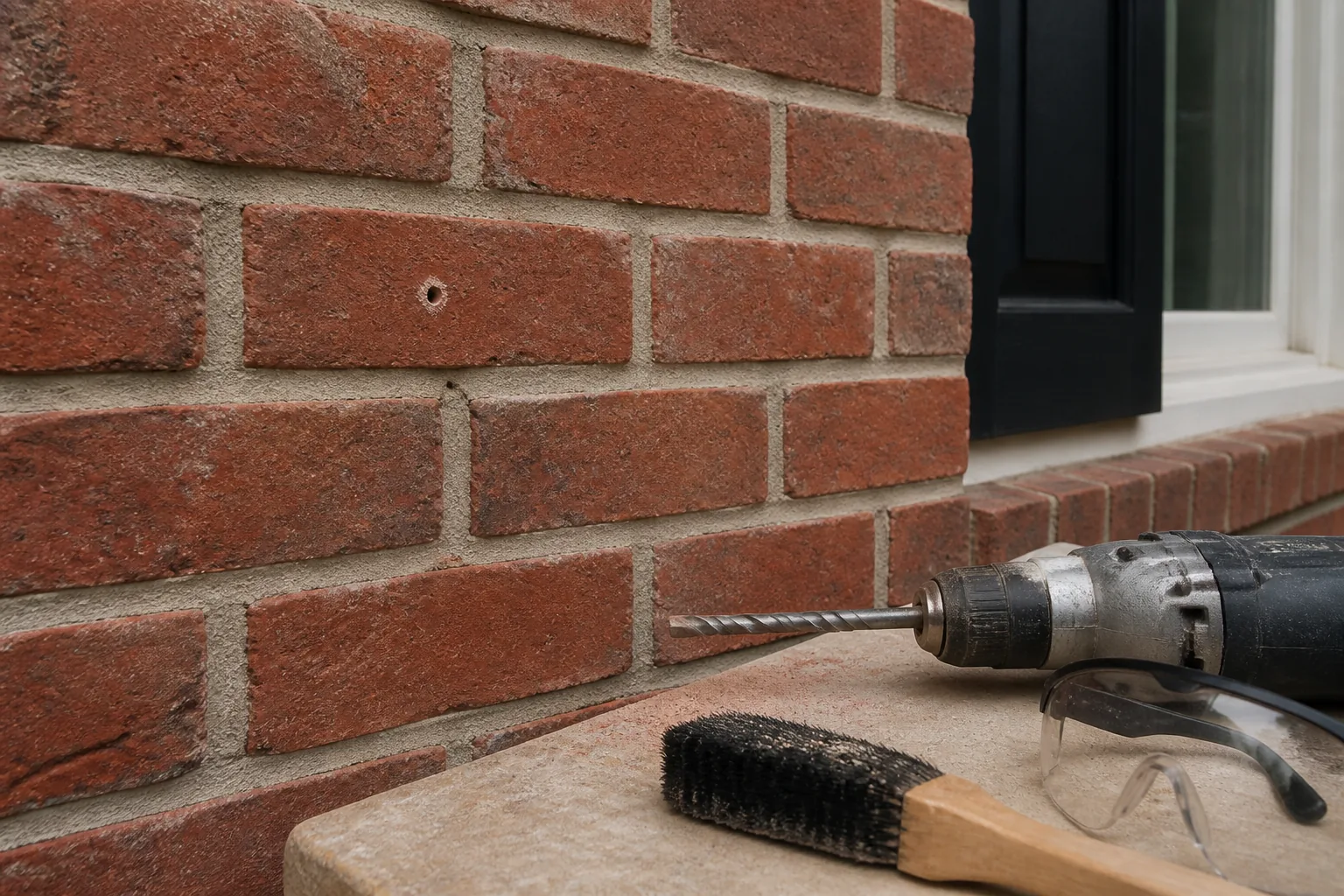
Identify the masonry assembly
Determine whether you have solid brick, hollow brick, concrete masonry units, stone, mortar joints or a thin adhered veneer. An exterior brick appearance may be a nonstructural veneer with a drainage cavity and framed wall behind it. Interior brick can also be a decorative facing.
Look for exposed edges, construction documents and repeating joint patterns. Do not rely on dust from an unplanned hole as the first identification method. If the attachment carries a large or consequential load, verify the assembly professionally.
- Solid, hollow or veneer unit
- Mortar condition and joint depth
- Wall thickness and backup
- Interior or weather-exposed location
- Historic or brittle material
Let the anchor instructions choose the base
Some masonry anchors list solid clay brick, some list concrete and some list specific hollow units. The instructions should identify permitted materials, hole diameter and depth, minimum edge distance, spacing and installation tool. If mortar is not listed, a mortar joint is not an approved shortcut.
Mortar can vary widely in strength and weathering, while drilling a brick may risk cracking a brittle unit. This tradeoff cannot be resolved by a universal rule. Match the actual wall and exact fastener data, and avoid transferring performance from concrete to brick.
- Approved base materials
- Required embedment
- Edge and joint distance
- Hole-cleaning method
- Interior or exterior suitability
Select the bit and drilling mode
Use the bit type and diameter named for the anchor. Bosch guidance distinguishes concrete and masonry bits and recommends impact mode for concrete, stone and full brick while using rotary mode for brittle hollow brick. The exact tool and material instructions still control.
Begin perpendicular and avoid excessive force. A wandering bit makes an oversized hole; uncontrolled hammering can damage a weak unit or mortar joint. Use a depth stop when appropriate and stop at rebar, metal, a void or unexpected material.
- Confirm drill chuck and bit compatibility
- Mark depth
- Control speed and alignment
- Manage dust
- Do not force through unknown resistance
Clean and install the hole correctly
Masonry drilling creates dust that can interfere with anchor expansion or bonding. Follow the specified blow-brush-blow, vacuum or other cleaning sequence. Wear the protection required by the tool and material instructions and contain dust from occupied areas.
Insert and set the anchor at the stated depth and torque. Do not repeatedly remove and reinstall an expansion anchor unless allowed. Keep the fixture flat so it does not pry on the fastener during tightening.
- Verify finished hole diameter and depth
- Clean with the stated method
- Use specified setting tools
- Tighten to the named torque when provided
Plan for water and future removal
Exterior penetrations can admit water and damage masonry, finishes or concealed wall components. Use corrosion-resistant hardware and flashing or sealing details required for the assembly. A bead of random caulk does not turn an unsuitable hole into a durable exterior connection.
Consider how the fixture will be removed and the hole repaired. Historic masonry, rental property and highly visible brick may warrant a reversible professional method. Avoid creating a line of abandoned test holes while searching for a workable substrate.
Frequently asked questions
Is mortar always safer to drill than brick?
No. Mortar condition varies, and many anchors are not rated for mortar. Follow the exact anchor’s approved base materials.
Can a concrete anchor be used in brick?
Only if the manufacturer explicitly lists the specific brick condition and installation.
Should hammer mode be used on hollow brick?
Manufacturer guidance may call for rotary mode on brittle hollow units. Follow both the bit and anchor instructions.
A practical next step
Before buying hardware, confirm the wall assembly and read the installation instructions for both the object and the exact fastener. If you need a starting category, use our Anchor Selector.
Sources and further reading
These primary and manufacturer resources support the safety and installation principles summarized above. Always use the current instructions for your exact product.
- CYL-1 Masonry Drill Bit Guidance — Bosch Professional