
Start with four checks
Confirm that the wall is actually drywall, estimate the complete installed weight, identify whether the load pulls downward or outward, and inspect the bracket holes. A television arm that swings away from the wall behaves differently from a flat picture frame of the same weight.
- Wall material and thickness
- Total load including brackets and contents
- Static, moving or cantilevered load
- Fastener count and spacing allowed by the bracket
Common anchor families
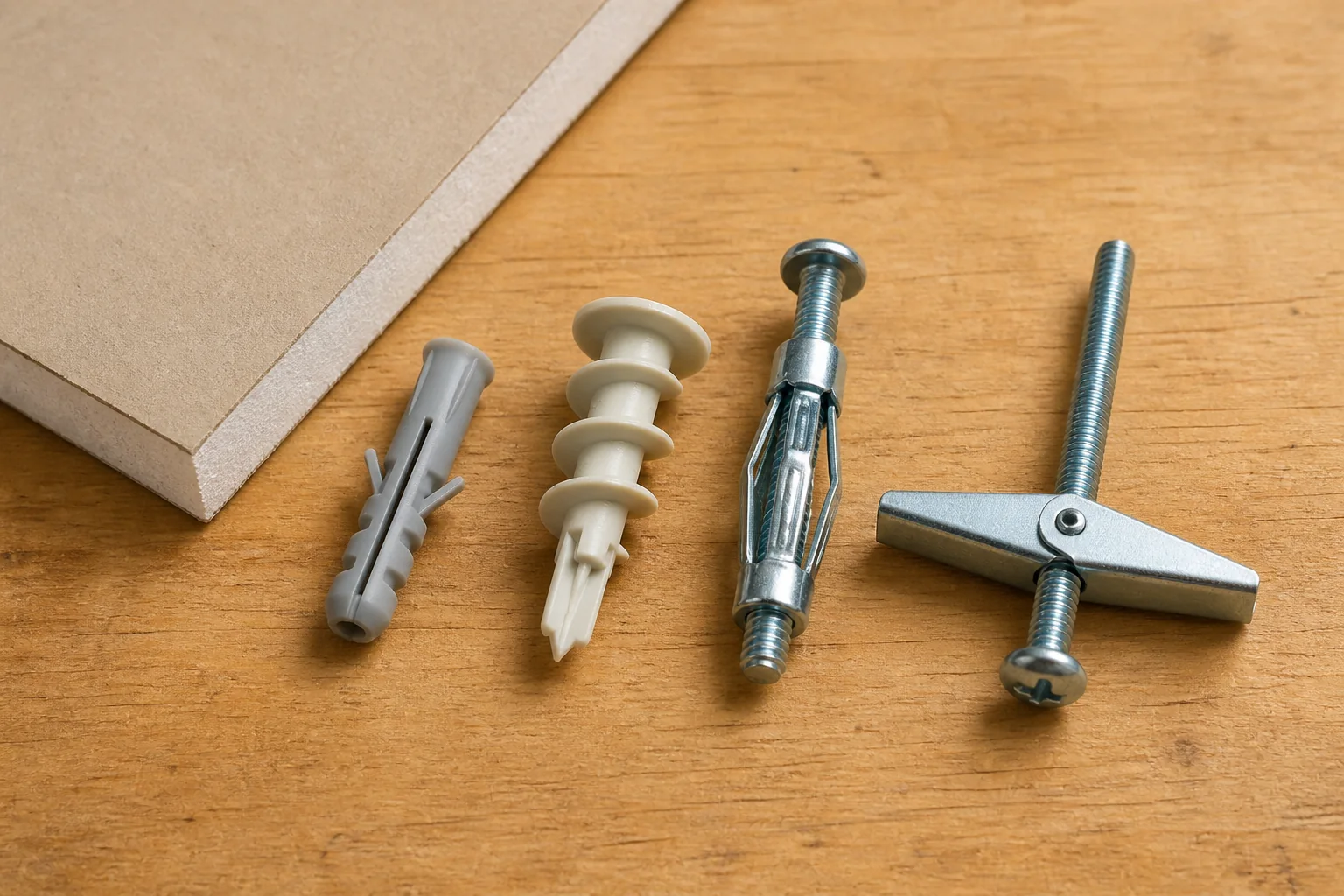
Plastic expansion anchors are best reserved for light, static items where the manufacturer explicitly lists drywall. Threaded self-drilling anchors are convenient for modest loads but remove more gypsum if they fail. Molly-style anchors expand behind the sheet and can suit medium loads. Toggle-style anchors spread force across a larger area behind the wall and are often considered for heavier non-safety-critical installations.
- Expansion: simple and light-duty
- Self-drilling: convenient with a larger entry point
- Molly/hollow-wall: reusable screw with a set sleeve
- Toggle: larger bearing area and a bigger required hole
When a stud is the better answer
Use framing whenever the installation instructions require it, the object moves, the cost of failure is high, or the wall surface is damaged. Cabinets, grab bars, climbing equipment and many full-motion TV mounts require blocking, framing or another engineered attachment—not a casual drywall-only choice.
Build a project-specific shortlist
Start with the mounting hardware rather than a store aisle. Record the object’s installed weight, the bracket-hole diameter, the number and spacing of usable holes, the drywall thickness, the cavity depth and whether a stud can be used. Those facts eliminate many anchors before price or advertised capacity becomes relevant.
Then download the instructions for each candidate anchor. Look for an explicit drywall-thickness range, required hole diameter, minimum cavity, screw size and any restrictions on overhead or dynamic loads. A rating shown without the test material and load direction is not enough information to transfer to a real wall.
- Reject anchors that do not list your wall thickness
- Reject fasteners that do not fit the bracket holes
- Confirm that every required anchor has clear cavity space
- Prefer framing when the mounted object moves or projects from the wall
Installation quality changes the result
A compatible anchor can still fail in a poor hole. Drill square to the wall, use the exact bit diameter, keep the face paper intact and stop if the gypsum crumbles or the hole becomes oval. For anchors that expand or toggle, follow the setting sequence instead of tightening until the wall dimples.
After installation, the bracket should sit flat without crushing the wall. Tightening one screw fully before the others can distort the bracket and concentrate force. Bring fasteners up evenly, apply only the torque described by the manufacturer and investigate any spinning, popping or continued movement.
- Mark and level every hole before drilling
- Check for utilities and obstructions
- Clean the opening without enlarging it
- Set anchors in the order specified
- Recheck the mounted item after its first normal use
Failure consequences set the safety threshold
The same anchor decision is not appropriate for a small frame and a folding desk. Consider who or what is below the object, how often it will be touched, whether children can climb on it and whether a leak or impact could weaken the wall. High consequences justify framing, blocking or qualified installation even when a package rating appears adequate.
Drywall-only fastening is generally a poor place for improvised safety margins. Adding more anchors too close together can weaken the sheet rather than multiply capacity. Use the spacing and edge distances in the exact instructions and treat damaged, damp or patched board as a different condition that needs evaluation.
Frequently asked questions
Can I choose an anchor by weight alone?
No. Wall thickness, load direction, bracket geometry, anchor spacing, cavity clearance and wall condition all influence the installation.
Do two anchors automatically hold twice as much?
No. Load may not divide evenly, and anchors placed too close together can share the same weakened area of gypsum.
Should the anchor be difficult to insert?
Follow the product instructions. An anchor that drops into an oversized hole or crushes the face paper is a reason to stop and reassess.
A practical next step
Before buying hardware, confirm the wall assembly and read the installation instructions for both the object and the exact fastener. If you need a starting category, use our Anchor Selector.
Sources and further reading
These primary and manufacturer resources support the safety and installation principles summarized above. Always use the current instructions for your exact product.