
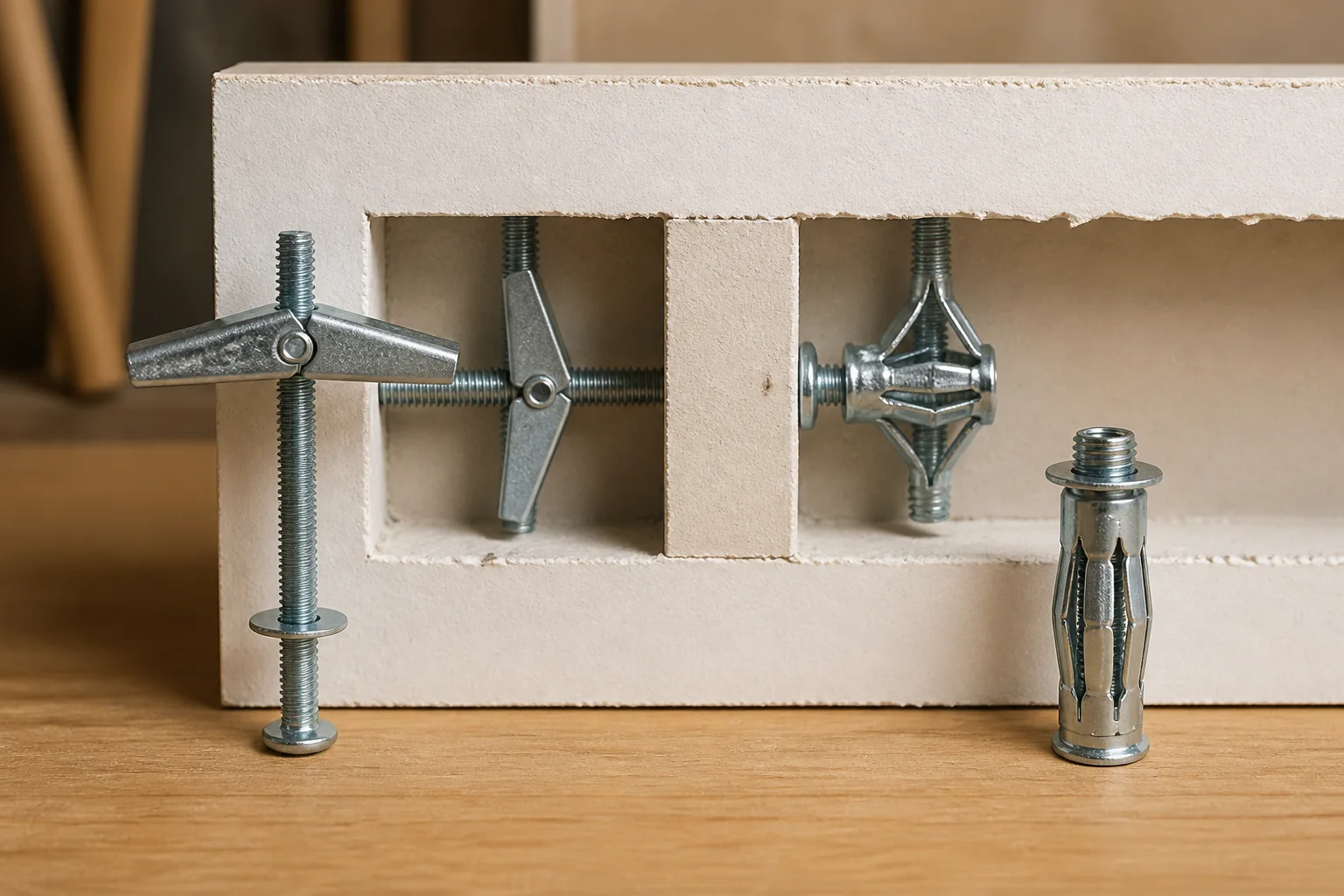
How each one works
A traditional spring toggle passes folded wings through a larger hole; the wings open in the cavity and bear against the wall's back. A molly-style anchor uses a metal sleeve that deforms and grips behind the sheet as it is set. Modern strap toggles use a different retaining mechanism but also create a bearing element behind the wall.
Decision factors
Compare the exact product's approved wall thickness, required hole, screw size, cavity clearance and published load information. Also consider what happens when the screw is removed: a traditional loose toggle wing may fall into the wall, while some hollow-wall anchors retain a threaded element.
- Required hole diameter
- Clear cavity depth
- Wall thickness range
- Need to remove and reinstall the screw
- Bracket hole size
- Consequences of failure
Ratings are not interchangeable
Never transfer a rating from one brand, size or test setup to another. Ratings can depend on wall material, load direction, spacing, edge distance and installation quality. Use the data and instructions supplied for the exact item.
Compare the installation envelope
A fastener must fit both the visible bracket and the hidden cavity. Record the hole diameter, wall-thickness range, folded or collapsed length, screw diameter and clearance needed for the mechanism to open or set. Insulation, closely spaced framing, masonry backup or a shallow service cavity can prevent correct deployment.
Traditional spring toggles typically need the screw and wings assembled before insertion, and the wings may be lost in the wall when the screw is removed. Molly-style anchors stay with the wall after they are set, but their grip depends on the sleeve deforming correctly over an approved thickness range.
- Entry-hole diameter
- Minimum cavity depth
- Approved wall thickness
- Bracket compatibility
- Whether screw removal is required later
Choose according to service behavior
A removable shelf bracket and a one-time static sign create different priorities. Molly anchors can retain a threaded point for removal and reinstallation when the product permits it. A toggle can offer a broad bearing element but may require continued tension while the screw is tightened.
Neither family is automatically appropriate for an articulating mount, ceiling attachment or safety-critical installation. The object maker’s approved substrates and fastening pattern come first. If framing is available and allowed, it may remove several hollow-wall uncertainties.
- Static versus moving load
- Need for future removal
- Access to every bracket hole
- Consequences if one fastener loosens
- Condition of the wall around the holes
Inspect the set without destructive testing
Follow the visual and torque cues in the exact instructions. The anchor should seat flush, the bracket should draw evenly to the wall and the screw should not spin indefinitely. A wall surface that dimples deeply or makes cracking sounds indicates damage rather than extra security.
Do not hang from the object or pull it sharply as a test. Use only the manufacturer’s prescribed verification, then observe the installation during normal service. Movement, growing gaps, powder or cracking are reasons to unload the hardware and investigate.
Frequently asked questions
Which holds more, a toggle or a molly?
There is no universal answer. Capacity is product-, size-, wall- and load-direction-specific.
Can a toggle be installed where insulation fills the cavity?
Only if the exact product can deploy fully in that condition. Do not assume insulation will move out of the way.
Can I remove and reinstall the screw?
Some molly and strap-toggle designs retain threads; traditional spring-toggle wings may fall. Check the product instructions.
A practical next step
Before buying hardware, confirm the wall assembly and read the installation instructions for both the object and the exact fastener. If you need a starting category, use our Anchor Selector.
Sources and further reading
These primary and manufacturer resources support the safety and installation principles summarized above. Always use the current instructions for your exact product.