
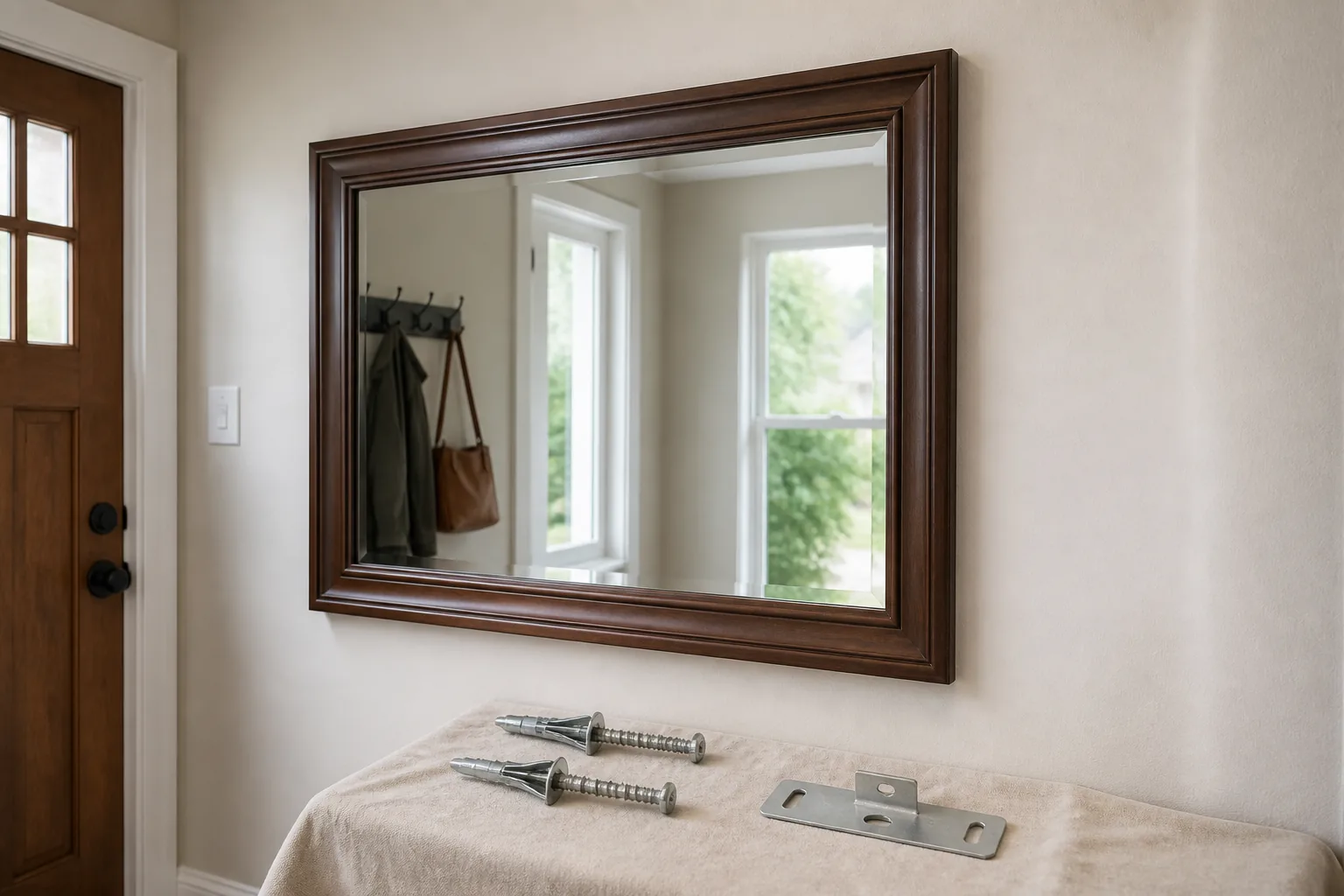
Inventory the complete hanging system
Weigh or obtain the documented weight of the mirror, including its frame. Inspect the back for a French cleat, D-rings, wire, keyholes or manufacturer-supplied rail. The hardware determines how many wall connections share the load and whether the mirror tends to pull away from the wall.
Check that the frame hardware is itself attached securely. A strong wall anchor cannot compensate for undersized screws in the frame, loose staples or a wire not rated for the mirror. Follow the mirror maker’s installation instructions whenever they are available.
- Mirror and frame weight
- Hanger type and number of wall points
- Distance between mounting points
- Frame-hardware condition
- Required wall clearance
Find the strongest acceptable attachment
Stud attachment is often preferred when the hanger geometry permits it. Mark stud edges, confirm the centers and compare them with the cleat or rail holes. If one or more points must land in a hollow section, use only a fastener whose instructions list the wall thickness, load direction and required spacing.
Do not assume that adhesive strips, picture hooks and construction anchors are interchangeable. Manufacturer limits may include frame dimensions, surface texture, paint cure time, environmental conditions and prohibited locations. A claimed capacity belongs to the exact product and installation pattern.
- Use a continuous cleat or rail only when approved
- Keep anchors separated by the required distance
- Avoid damaged or patched drywall
- Use every safety lock supplied with the hanger
Lay out the mirror before drilling
Make a paper or cardboard template showing the mirror perimeter and wall-fastener points. Tape it lightly at the intended height, then check nearby doors, outlets, trim, lighting and furniture. Use a level and measure from a stable reference instead of the ceiling, which may not be level.
Identify potential wiring and plumbing before every hole. A bathroom or wall shared with plumbing deserves extra caution. If a detected stud does not match the expected layout, investigate rather than forcing the location.
- Mark the mirror outline
- Transfer actual hanger spacing
- Verify level and sight lines
- Screen each hole for concealed hazards
Install and lift in a controlled sequence
Install wall hardware exactly as directed, including pilot holes, hole cleaning, setting tools and torque. For a cleat, verify its orientation and full seating. Bring multiple screws up evenly so the rail does not twist against the wall.
Use two people or professional handling for a mirror that is awkward, large or difficult to grip. Protect the floor and keep fingers out of the pinch zone. Engage the hanger fully, add any anti-lift or bottom restraints and confirm that the mirror does not rock.
- Prepare a padded staging area
- Use suitable lifting help
- Engage the full hanger length
- Install locking or restraint hardware
- Clean the mirror only after it is secure
Inspect the installation over time
Check the gap at the wall, the bottom alignment and visible hardware after the first day and periodically thereafter. Remove the mirror if it begins to tilt, click, scrape, loosen or shed gypsum dust. Do not tighten a moving fastener while the mirror remains unsupported.
Humidity, impact, repeated door vibration and changes to the frame can affect an installation. Treat any move to a new wall as a fresh project; do not reuse anchors or adhesive products unless their maker explicitly permits reuse.
Frequently asked questions
Can two hooks be treated as double capacity?
No. Load sharing may be uneven, and each product has spacing and installation requirements.
Can adhesive strips hold a heavy mirror?
Only a specific product used within all of its stated weight, size, surface and location limits. Do not use them for irreplaceable items where prohibited.
Is hanging wire suitable for every mirror?
No. The frame, wire, attachment points and wall hooks must all be approved for the arrangement.
A practical next step
Before buying hardware, confirm the wall assembly and read the installation instructions for both the object and the exact fastener. If you need a starting category, use our Anchor Selector.
Sources and further reading
These primary and manufacturer resources support the safety and installation principles summarized above. Always use the current instructions for your exact product.