
Clues you can check without drilling
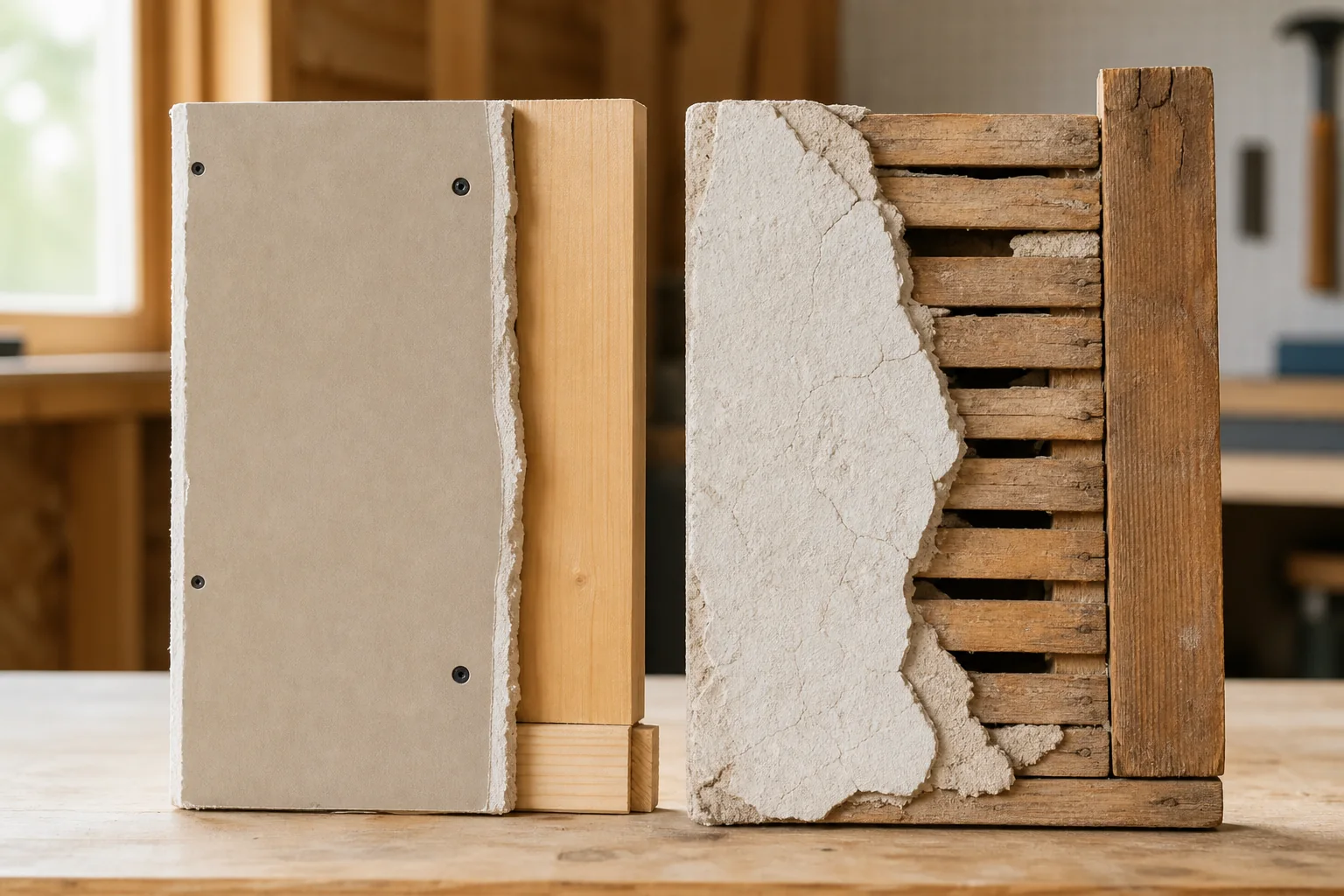
Drywall is commonly installed in large sheets and may sound uniformly hollow between studs. Traditional plaster may feel harder, vary in thickness and show fine age-related cracking. Home age is a clue, not proof—many older houses have remodeled rooms.
- Look for sheet seams or broad repairs in raking light
- Compare the sound at several points
- Inspect an unfinished utility area
- With power off, look at a safe exposed edge near an existing cover plate
What the edge may reveal
Gypsum drywall typically has paper faces around a gypsum core. Plaster may appear as a hard finish over wood strips, metal lath or gypsum lath. Do not insert tools into an electrical box or disturb unknown insulation simply to identify a wall.
Why the distinction matters
A fastener that depends on clean paper-faced drywall may behave differently in brittle plaster. The cavity depth, lath and stud-finding method also change. Once identified, follow guidance written for that exact assembly.
Use an evidence ladder
Begin with observations that do not disturb the finish: construction date, visible cracking patterns, wall thickness at a doorway and the sound at several locations. Next inspect an already exposed edge in an unfinished basement, attic or utility opening. Only consider a new test point when the result will change the mounting plan and the location has been screened for utilities and hazardous materials.
Do not treat a single clue as proof. A prewar home can contain replacement drywall, while a newer addition can incorporate plaster repairs. Different rooms—and even different sections of one wall—may use different assemblies.
- History and renovation records
- Existing exposed edge
- Wall thickness and surface hardness
- Multiple locating methods
- Controlled inspection only if still necessary
What changes after identification
Paper-faced drywall depends on intact gypsum and face paper around a correctly sized hole. Traditional plaster is harder and more brittle, and its wood, metal or gypsum lath changes what lies behind the finish. A fastener described only for drywall should not be assumed suitable for plaster simply because both walls have a cavity.
Stud finders may respond to lath, fasteners, foil-backed materials or dense repair areas. Confirm framing with more than one signal and use the mounting manufacturer’s method for the identified assembly. Avoid striking or flexing plaster, which can loosen keys beyond the visible hole.
- Select the drill bit for the finish and substrate
- Account for the full finish thickness
- Protect brittle edges from impact
- Verify that the fastener lists the actual wall assembly
Older-home hazards deserve a separate check
Walls in homes built before 1978 may have lead-based paint. Drilling, cutting or sanding painted surfaces can create hazardous dust. The EPA advises determining whether lead is present and using lead-safe practices; it recommends hiring a lead-safe certified contractor for renovation work in pre-1978 homes.
Plaster systems can also conceal older wiring, piping and previous repairs. Stop if material, dust, resistance or wall construction differs from what you expected. Identification is not a reason to push through an unknown layer.
Frequently asked questions
Does a hollow sound prove the wall is drywall?
No. Both drywall and some plaster assemblies can sound hollow, and repairs or insulation can change the sound.
Can a stud finder distinguish drywall from plaster?
Usually not by itself. Lath and old fasteners can create confusing readings, so combine methods.
Is wall age enough to identify the material?
No. Age is only a clue because rooms may have been remodeled with different materials.
A practical next step
Before buying hardware, confirm the wall assembly and read the installation instructions for both the object and the exact fastener. If you need a starting category, use our Anchor Selector.
Sources and further reading
These primary and manufacturer resources support the safety and installation principles summarized above. Always use the current instructions for your exact product.
- Plaster Repair and Resurfacing Systems — USG
- Lead-Safe Renovations for DIYers — U.S. Environmental Protection Agency