
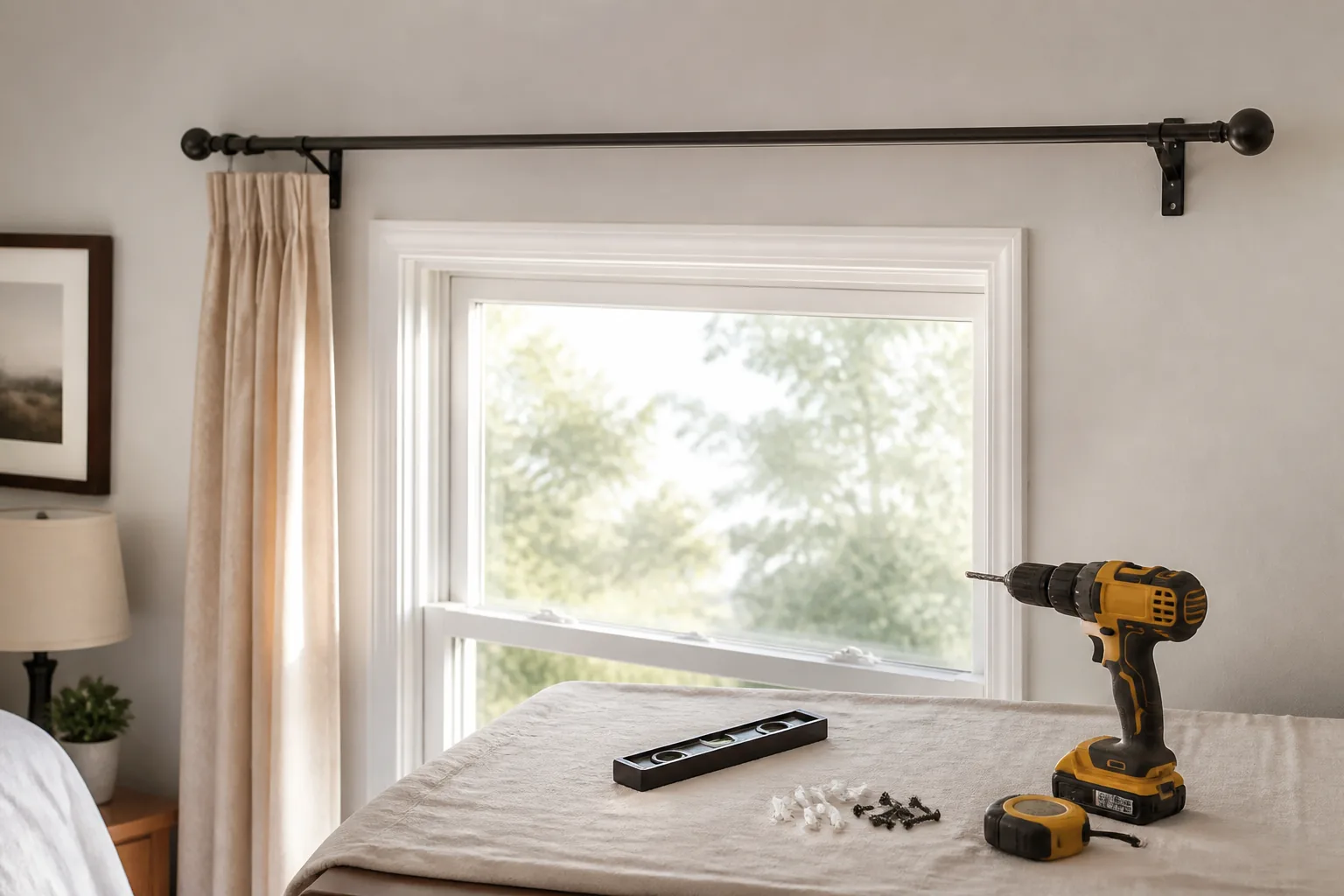
Start with the complete curtain assembly
Include the rod, finials, rings, curtains and any liner when estimating the installed load. Wide windows can require a center support even when the rod feels stiff while empty. Heavy blackout fabric and frequent opening create more demand than a stationary sheer panel.
Read the rod manufacturer’s bracket-spacing and substrate instructions. Count the supplied screws and anchors, but do not assume they fit every wall. Replacement fasteners must also fit the bracket holes and the intended base material.
- Total fabric and hardware weight
- Rod span and diameter
- Number of supports
- Curtain opening direction
- Daily movement and child access
Choose height and projection
Mock up the curtain edge and bracket position before drilling. Confirm that the rod clears trim, blinds, shades, handles and the top of the window. Leave room to insert the rod and remove it later without hitting the ceiling.
Use a tape measure and level from a reliable horizontal reference. Check both brackets against the window, but remember that trim and ceilings can be out of level. For multiple windows, sight lines across the room may matter as much as a single measurement.
- Bracket height
- Distance beyond the trim
- Rod projection from the wall
- Center-support location
- Clearance for removing the rod
Investigate the wall around the window
Framing often surrounds rough window openings, but its exact position and width vary. Use more than one locating method rather than assuming a screw just outside the trim will hit wood. Metal corner bead, headers, shims and layered finishes can confuse detection.
If a bracket hole lands in framing, use the rod maker’s approved wood-fastening method and calculate actual embedment. If it lands in a cavity, use an anchor explicitly suited to the drywall thickness and dynamic use. Move the bracket only within the rod’s allowed geometry.
- Confirm—not assume—framing
- Mark concealed-hazard zones
- Match each hole to its base material
- Maintain required distance between anchors
Install brackets as a matched set
Mark all holes, confirm level and drill before tightening any bracket fully. Seat anchors according to their instructions. Tighten bracket screws evenly while keeping the bracket aligned; excessive torque can crush the board or twist a thin bracket.
Install the rod, center support and any retaining screws. Open and close the curtains gently through their full range. Rings should not strike a bracket, and the rod should not climb out of its supports.
- Use every specified bracket
- Keep bracket cups aligned
- Install rod-retaining screws
- Distribute curtain fullness evenly
Maintain a frequently used installation
Recheck the brackets after several days of normal use. Look for rotation, a growing wall gap, loose set screws or abrasion from the rod. Teach children not to pull or climb on curtains and keep furniture from pressing against them.
If a fastener loosens, remove the curtain load before touching it. Diagnose the wall and hole rather than installing a longer random screw. Relocation to framing or a documented repair is safer than repeatedly tightening damaged drywall.
Frequently asked questions
Do curtain rods always need studs?
Follow the rod instructions. Studs are useful when available, but some systems permit listed hollow-wall anchors for compatible loads and walls.
Why is a center bracket needed?
It reduces span and rod deflection. Use it when supplied or required for the rod width and curtain weight.
Can I screw into window trim?
Only when the product instructions permit it and the trim has adequate, verified support. Decorative casing alone may not be structural.
A practical next step
Before buying hardware, confirm the wall assembly and read the installation instructions for both the object and the exact fastener. If you need a starting category, use our Anchor Selector.
Sources and further reading
These primary and manufacturer resources support the safety and installation principles summarized above. Always use the current instructions for your exact product.
- Sheetrock Installation and Finishing Guide — USG
- General Electrical Safety Requirements — Occupational Safety and Health Administration