
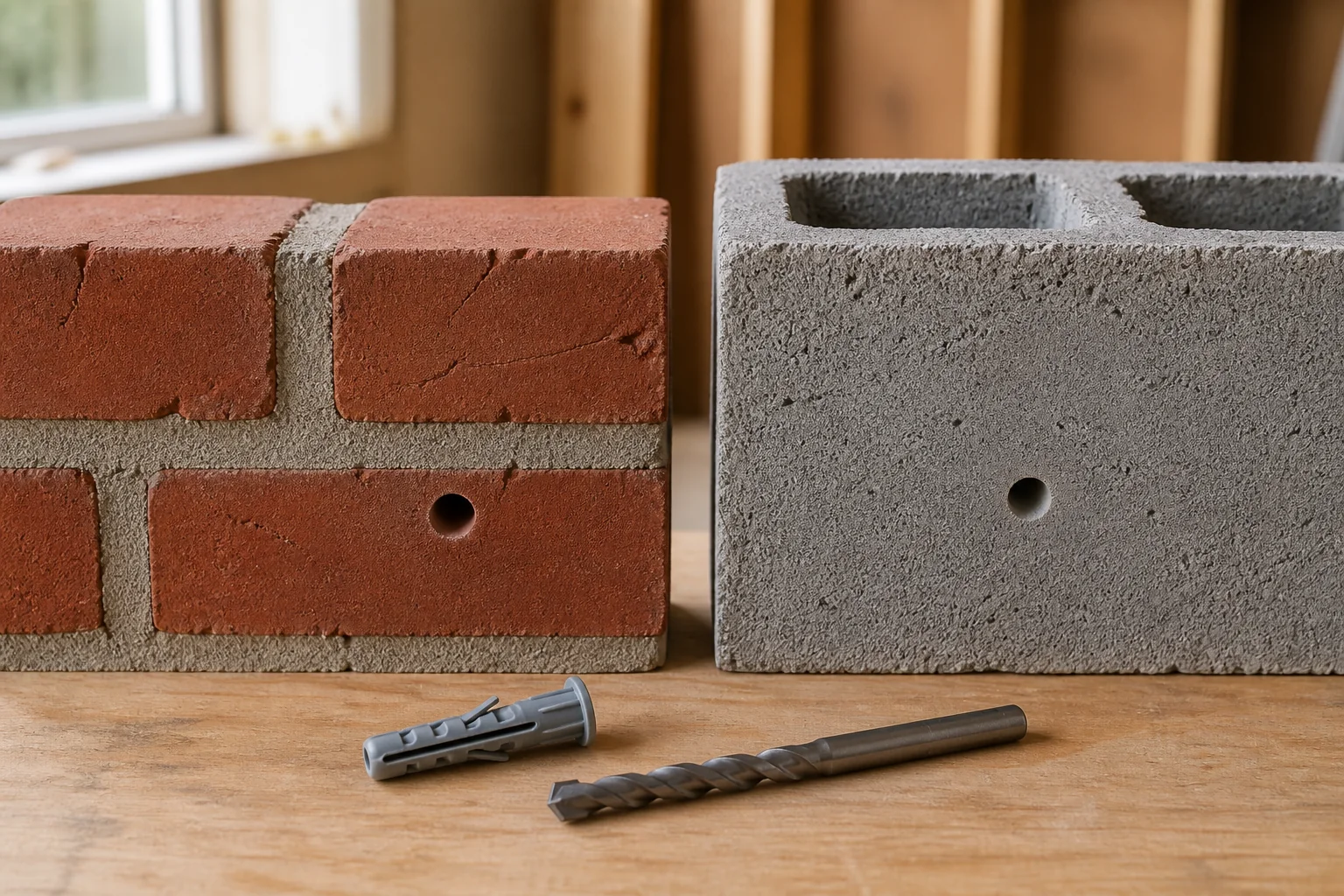
Masonry is not one substrate
Poured concrete, solid clay brick, hollow brick, concrete masonry unit, stone, mortar and adhered veneer have different density, geometry and failure behavior. A thin masonry-looking finish may cover framed construction and contribute no structural embedment.
Use construction records, exposed edges and known wall details to identify the assembly. Dust color from an accidental hole is weak evidence and should not be the first test. High-consequence loads warrant professional verification.
- Poured or precast concrete
- Solid or hollow brick
- Solid or hollow concrete block
- Natural stone
- Mortar joint
- Thin or anchored veneer
Evaluate condition and location
Look for cracks, spalling, loose units, weathered mortar, moisture and previous holes. Edge distance matters around corners, openings and the edge of an individual brick. A seemingly sound surface coating can conceal weak material beneath.
For exterior work, plan water management and corrosion resistance. Penetrations can admit water into veneer cavities or freeze-thaw zones. Historic masonry can be especially sensitive to irreversible holes and mismatched repair materials.
- Cracked or intact
- Solid bearing area
- Distance from edges and joints
- Interior, wet or exterior exposure
- Historic significance
Choose an anchor from approved base materials
Manufacturer data should list the allowed masonry, anchor diameter, embedment, hole size, minimum spacing, edge distance and setting method. A concrete performance table cannot be transferred to brick, and an anchor not listing mortar should not be placed there by assumption.
Common mechanisms include concrete screws, sleeve or wedge expansion, drop-in anchors, masonry screws and adhesive systems. Each has restrictions. Hollow units may need a screen, toggle or product designed for the unit geometry.
- Exact base material
- Tension and shear direction
- Embedment and fixture thickness
- Spacing and edge distance
- Temperature and corrosion environment
Match the bit and drilling mode
Use the exact bit diameter and type named by the anchor maker. Bosch guidance distinguishes bits and modes for concrete, full brick and brittle hollow brick. Hammer action that is effective in solid concrete can damage a fragile hollow unit.
Hold the drill perpendicular and use a depth stop when appropriate. Worn bits, side pressure and repeated redrilling enlarge the hole. Stop at reinforcement, metal, a void or unexpected material. Do not cut rebar or post-tensioning without authorization and engineering evaluation.
- Correct shank and chuck
- Named diameter
- Required depth
- Compatible rotary or impact mode
- Controlled dust collection
Clean and set the anchor
Dust can prevent seating, thread contact, expansion or adhesive bond. Follow the exact brushing, blowing or vacuuming sequence. Wear appropriate respiratory and eye protection and avoid dispersing silica-containing dust into occupied areas.
Install with the required setting tool and tighten to the named torque where applicable. Keep the fixture flat and do not reuse an expansion hole unless the manufacturer permits it. Record the anchor model and installation so future removal or inspection is informed.
- Inspect the finished hole
- Perform every cleaning step
- Use specified washers and nuts
- Torque with an appropriate tool
- Unload any connection that begins to move
Escalate demanding installations
Guardrails, overhead suspension, structural supports, seismic attachments, large awnings and safety equipment are not routine consumer anchor selections. Cracked concrete and near-edge anchors can require engineered products and calculations.
When the base is unknown, reinforcement is in the drilling path or the failure consequences are serious, use a qualified designer or installer. Relocating a fixture is often safer and less costly than turning one uncertain hole into several.
Frequently asked questions
Should I drill into brick or mortar?
There is no universal choice. Use the exact anchor’s approved base materials and account for condition, spacing and edge distance.
Can concrete anchors be used in hollow block?
Only products whose instructions list the specific hollow unit and installation should be considered.
Why clean a masonry hole?
Dust can prevent correct seating, expansion, thread engagement or adhesive bonding.
Sources and further reading
- CYL-1 Masonry Drill Bit Guidance — Bosch Professional
- General Electrical Safety Requirements — OSHA